- HINTS OF ACTIVE VOLCANOES FOUND ON VENUS, NEW STUDY SAYS - 06.01.2020
- * VENUS BEFORE IT DIED: JANUARY 2020 TIME CROSS - Farsight - Jan 1, 2020
- *
PARADISE TO HELL: CATACLYSM MIGHT HAVE TURNED VENUS UNINHABITABLE EONS AGO,
SCIENTISTS CLAIM - 23.09.2019
"Our hypothesis is that Venus may have had a stable climate for billions of years", said Michael Way, planetary scientist from NASA's Goddard Institute for Space Studies. "It is possible that the near-global resurfacing event is responsible for its transformation from an Earth-like climate to the hellish hot-house we see today."
The authors of the research, whose findings were presented at the EPSC-DPS Joint Meeting 2019 in Geneva, postulated that Venus "spent most of its history with surface liquid water, plate tectonics, and subsequently a stable temperate climate akin to that of Earth through much of its own [history]," and this climatic stability might have lasted for up to 3 billion years.
"Something happened on Venus where a huge amount of gas was released into the atmosphere and couldn't be re-absorbed by the rocks. On Earth we have some examples of large-scale outgassing, for instance the creation of the Siberian Traps 500 million years ago which is linked to a mass extinction, but nothing on this scale. It completely transformed Venus," Way explained. -
WHAT WOULD HAPPEN IF A MASSIVE OORT CLOUD COMET STIKES EARTH?
ANSWER: VENUS
After several million years, the planet would cool down and a crust would form. The crust creates an insulation barrier between the hot magma and the atmosphere. Surface temperatures would drop below 1,000o F. The average temperature at the surface of Venus is 865o F. - or
WHAT WOULD HAPPEN IF A MASSIVE OORT CLOUD COMET STIKES EARTH?
ANSWER: VENUS -
(10) WHAT WOULD HAPPEN IF A MASSIVE OORT CLOUD COMET STRIKES EARTH? - James
Marusek
The destruction of Earth's crust would release flood vulcanization on a massive scale. The surface of the Earth would become a molten sea of lava. Vulcanization would release vast quantities of compressed gases into the atmosphere. Magma contains several dissolved gases. These gases consist predominantly of steam (90%), carbon dioxide, sulfur dioxide, hydrogen sulfide, hydrogen and fluorine. The impact would produce a thick heavy atmosphere. Magma is very hot, with temperatures ranging from 1,650 to 2,200oF. Heat release from the magma would dramatically expand the atmospheric envelope to many times its original thickness. An outer layer of clouds composed of water vapor and sulfur dioxide would form around the entire planet. The outer layer would reflect most of the solar radiation back into space, leaving the planet in continual darkness. The inner thick layer of carbon dioxide would act as a heat blanket, sealing and trapping the volcanic heat at the surface of the planet. Carbon dioxide is very effective at blocking infrared radiation. The planet's surface temperature would hover around 2000oF.
After several million years, the planet would cool down and a crust would form. The crust creates an insulation barrier between the hot magma and the atmosphere. Surface temperatures would drop below 1,000o F. Clouds composed of sulfuric acid droplets would rain acid down onto the planet and over time bleed out into surface mineralization. Sulfur dioxide/sulfuric acid clouds would thin substantially. Sunlight, although dim, would make its way to the planet's surface. The atmospheric shield inhibiting photosynthesis would dissolve away. The intense period of vulcanization on the planet would begin to come to an end.
What would happen if a massive Oort Cloud comet were to strike the Earth? The answer is Venus. It's not everyday that we have the opportunity to witness a planet being reborn. In the case of Venus, the big question is "Will it be a stillbirth?" Or maybe a better question is "Should we help in the delivery?" -
A GIANT PLANETARY SMASHUP MAY HAVE TURNED VENUS HOT AND HELLISH - MARCH 10,
2016
A collision with a large object may have triggered changes deep inside the planet that ultimately affected its atmosphere
According to their models, if a spherical object between 500 and 1,000 miles wide hit Venus, energy from the colliding object would have heated the upper mantle enough to melt it. That melted portion would have risen to the surface, spreading into a long, shallow layer just beneath the crust. Water and carbon dioxide within the mantle could then be released to the surface as gases, which could have caused a significant shift in the planet's atmosphere. - METEORITE COLLISION
Here is a Japanese dramatic simulation of what would happen to Earth if it were hit by a gigantic meteorite as is anticipated to occur 1800 years from now. This event, according to Vedic prophecy (see List 5), is actually a series of about 12 (or 7, or 3) smaller, but similar impacts. - Go to the YouTube website and sign in (or register). Then search for the term "Meteorite Collision". The missing Japanese video in the above hyperlink should be the first or near the first one listed.
-
PLANET VENUS SLOWING DOWN - February 14, 2012
The rotation of the planet Venus is slowing down, according to recent data gathered by the European Space Agency's Venus Express satellite. Peering through the planet's dense atmosphere with infrared imaging, the orbiter saw surface features up to 20 km (12.4 miles) from their expected location. The discrepancy could be explained if the Venusian day has lengthened by six and a half minutes since the planet's speed of rotation was established 16 years ago.
It is not actually the spin rate of Venus that is slowing down, but rather crustal motion that is still occurring from the impact of a giant meteor on Venus that happened several million years ago. -
VENUS: NO GREENHOUSE EFFECT - NOVEMBER 22, 2010
The flip side of the entrenched incompetence in science today is that all it takes is scientific competence to make revolutionary discoveries, or fundamental corrections to current dogma. Being a competent physicist rather than an incompetent climate scientist (which 97% of them demonstrably are), I was able recently to post an answer on yahoo.com to a question about the greenhouse effect on Venus, an update to which I give here: -
THE SURFACE FEATURES OF VENUS
Much of the surface of Venus appears to be rather young. The global data set from radar imaging reveals a number of craters consistent with an average Venus surface age of 300 million to 500 million years.
"The Oort Cloud contains many large comets, some in the order of 200 miles in diameter. If one of these behemoths were to impact Earth, it would turn Earth into a sea of fire, of lava. There would no longer be any oceans. It seems logical that one of these large comets hit Venus a few hundred million years ago. The surface of the planet shows signs of massive vulcanization. The surface is young, not older than 800 million years. The atmosphere is 90 times denser than Earth's. The atmosphere at the surface is 96 percent carbon dioxide. But above the surface the clouds are composed of sulfuric acid droplets. The surface temperature on Venus is 900 degrees F. Scientist theorize this high temperature is due to a runaway greenhouse effect. That theory does not make a lot of sense. Venus is one of the brightest planets in the nights sky. Sunlight rather than being absorbed by the planet is being reflected back into outer space. Therefore the atmosphere is not in a condition of runaway greenhouse effect. On Earth, magma contains compressed gases of water vapor, carbon dioxide and sulfur dioxide. These gases are released when the magma hits the surface. We have experienced a large lava flow a few hundred years ago. Temperatures were depressed for a few years because the sulfur dioxide restricted some of the sunlight from heating the Earth's surface. The heat on the surface of Venus is internally generated heat not heat from solar radiation. The heavy gas cloud surrounding Venus is like an insulation blanket that traps the surface heat. An impact from a 200 mile diameter LPC produces a tremendous amount of heat. It is off the scale. The crust of the planet would be destroyed. Magma would release massive amounts of carbon dioxide and sulfur dioxide and produce a super dense atmosphere. The planet would over millions of years reconstitute a hard crust that would further insulate the surface. The heat would be trapped inside the magma deep within the planet. The heat would be slowly released through the insulated crust and very dense atmosphere over the next several hundreds of million of years." - Private communication James A. Marusek - 4 Jun 2003
Should Vulcan exist, as this web site suggests, meteorite collisions with Earth may be more frequent than is currently believed. - VENUS PROBE IMAGES HINT AT ANCIENT OCEAN - July 14, 2009
Long before Venus became a hot, dry and barren planet with a choking mass of carbon dioxide for an atmosphere, it might have once been home to shifting continents and an ocean of water, according to the latest data from a European space probe.
The imagery showed that different areas of the planet had different surface temperatures, information that provided insight into the chemical composition of different areas of the planet.
A look at the highland plateaus suggests they are made of a substance similar to granite, which is formed on Earth when ancient rocks made of basalt are driven down into the planet by shifting continents, mix with water and then re-emerge through volcanic activity.
The presence of granite-like rock on the plateaus suggest a similar early history on Venus, Nils Muller, a researcher with the Joint Planetary Interior Physics Research Group in Berlin, said in a statement.
Liquid water on Venus?
"If there is granite on Venus, there must have been an ocean and plate tectonics in the past," said Muller. -
WAS VENUS ALIVE? 'THE SIGNS ARE PROBABLY THERE'
AM: Did some huge impact melt the surface? Or was it the last gasp of volcanic activity?
DG: Clearly, whatever this second great transition was, it involved massive amounts of volcanism. You can see these flows that appear to be flood basalts all over, covering 80 percent of the planet. The remarkable thing is that they seem to be all the same age. The crater density is relatively uniform and random around the planet. So the planet seems to have been flooded with basaltic lavas in a geologically short period of time, simultaneously around the planet.
Now, you talk to some geologists and they argue with that and they say, well, it wasn't simultaneous. But looking at the map of craters on Venus, all of them seem relatively pristine, and there are no older ones. You can't escape the conclusion that something dramatic changed on Venus at that time that had the effect of re-paving the surface. -
VENUS HAS 'HEAVY METAL MOUNTAINS'
Detailed calculations suggest that lead and bismuth are to blame for giving Venus its bright, metallic skin.- The temperature on the surface of Venus is 894o F (480o C).
- The boiling point of Lead at one Earth atmosphere pressure is 1740o C
- The boiling point of Bismuth at one Earth atmosphere pressure is 1560?o C
-
VENUS
These clouds completely obscure our view of the surface. This dense atmosphere produces a run-away greenhouse effect that raises Venus' surface temperature by about 400 degrees to over 740 K (hot enough to melt lead). Venus' surface is actually hotter than Mercury's despite being nearly twice as far from the Sun. The pressure of Venus' atmosphere at the surface is 90 atmospheres (about the same as the pressure at a depth of 1 km in Earth's oceans). The impact of a massive meteorite could easily vaporize most of the Lead and Bismuth in Venus's curst and later it would be deposited on the "cooler" mountain peaks. - (6) GIANT IMPACT ON VENUS COULD HAVE HALTED ITS ROTATION
-
AEON _ The Youthful Atmosphere of Venus
Charles Ginenthal offers some evidence challenging the conventional portrait of Venus: the evidence implies Venus is either a new planet or has experienced a most unusual history. - Page 5 -
EARTH-LIKE VENUS
ESA's Venus Express has revealed Venus as never before. For the first time, scientists are able to investigate from the top of its atmosphere, down nearly to the surface. They have shown it to be a planet of surprises that may once have been more Earth-like, and still is, to a certain extent. - ATMOSPHERE AND WEATHER OF VENUS
- VENUS UNVEILED
-
DOUBT CAST ON VENUS CATASTROPHE
But craters on Venus are distributed randomly over the whole planet. This has led some scientists to the conclusion that most of the surface is of similar age. -
MYSTERIOUS BRIGHT SPOT FOUND ON VENUS - 29 July 2009
A strange spot emerged on Venus last week, and astronomers are not sure what caused it.
The spot is bright at ultraviolet wavelengths, which may argue against a meteoroid impact as a cause. That's because rocky bodies, with the exception of objects very rich in water ice, should cause an impact site to darken at ultraviolet wavelengths as it fills with debris that absorbs such light, says Sanjay Limaye of the University of Wisconsin-Madison and a member of the Venus Express team. -
ROCK PROPECY
VENUS IMPACT COVER UP
The 15 July impact happened in Venus's southern hemisphere. -
SPOT OF BOTHER ON VENUS - BUT IT'S NO WAR OF THE WORLDS ASTRONOMERS
Professor John Brown, who holds the post by Royal appointment, said:
"It's pretty surprising, but I'd certainly stop short of any speculation of UFOs or aliens.
Why is the subject of UFO or aliens being brought up? Who would even make such an association? But now that is has been brought up, it is worth remembering that aliens have warned us about the current impact threat and that they were instrumental in building Noah's Ark! -
A NEW BRIGHT SPOT ON VENUS - July 21, 2009
The Solar System is breaking out in spots. First Jupiter took a smack from a passing asteroid or comet, manifesting as a dark scar in the Jovian atmosphere, and now Venus is sporting a brilliant white spot in its southern polar region.
In an alert to fellow amateur astronomers, Venus observer Frank Melillo reports on his images captured on 19 July: "I have seen bright spots before but this one is an exceptional bright and quite intense area." - THE SOLAR SYSTEM II
-
THE MYSTERIOUS RIDGES AT THE MOUTH OF TIU VALLES
The mouth of Tiu Valles is an estuary-like landform. On Earth, an estuary is the tidal mouth of a river valley, or the end that meets the sea and fresh water comes into contact with seawater. In such an area, tidal effects are evident.
Tiu Valles is located at approximately 27?North and 330?East. The sun illuminates the scene from the North West, the lower left-hand side in the image.
-
HUGE IMPACT CRATER DISCOVERED ON PLANET MERCURY - 30 April 2009
The newly-discovered gigantic crater, called Rembrandt, stretches more than 700 kilometers (430 miles) in diameter. The bowl-like indentation in Mercury's surface was likely formed about 3.9 billion years ago by an impacting space rock. It has managed to survive with parts of its original floor still intact, without being filled in by later flows of volcanic lava, as most craters have been.
-
Scientists find new evidence of liquid WATER beneath Mars' south polar
ice cap in major breakthrough - Sep 29, 2022
-
MARS COULD HAVE BEEN WET FOR MUCH LONGER THAN PREVIOUSLY BELIEVED -
Feb 07, 2022
Billions of years ago, Mars was a much different place than it is today. During the same period when life was first emerging on Earth, Mars had a thicker atmosphere, warmer surface temperatures, and flowing water on its surface. Evidence of this warmer, wetter past is preserved on the planet’s surface today in the form of river channels, lakebeds, alluvial fans, and sedimentary deposits. When this period began, and how long it lasted, remains the subject of much debate for scientists. - NASA PHOTO SHOWS THREE MASSIVE TOWERS ON MARS - Jan 04, 2017
-
"THE DEATH OF MARS" -DID A PLUTO-SIZE ASTEROID IGNITE ANCIENT CLIMATE
CHANGE? - May 16, 2021
In the mid-1980s, a group of American archaeologists pored over satellite images trying to understand what had become of the Mayan civilization that had once ruled over Mexico’s Yucatan Peninsula, discovered a pattern: a near-perfect ring of sinkholes -cenotes- about 200 kilometers across, encircling the Yucatecan capital, Merida, and port towns of Sisal and Progreso. A pattern created by an ancient asteroid explosion that one young NASA scientist thought may yield clues to the lost ocean and atmosphere of Mars.
Defining Event in the History of Planet Earth
Adriana Ocampo, then a young planetary geologist at NASA, saw not just a huge ring, but a bullseye –the impact crater of an asteroid that hit with the force of 10 billion Hiroshima nuclear bombs that scarred the planet in ways still being revealed 66 million years on."The Day the Earth Rained Glass"
The 'Aha!' Moment
"Driving through the lonely, windswept ranchlands of southwestern North Dakota, we got out of our field vehicle, passed through through a rickety gate in a flimsy barbed-wire fence, and entered a postage-stamp-sized plot of eroded landscape. Soon we were digging out fossil fish that died 66 million years ago choking on melt-glass spherules thrown ..."
The key to her 'Aha! moment' had been an intuition she' picked up after working with a legendary figure in space science, Eugene Shoemaker... Shoemaker instructed Ocampo that near perfect circles were unlikely to have been caused by other terrestrial forces, and could provide clues to Earth's geological development.
Mystery of the Two-faced Nature of Mars
Astronomers from UC Santa Cruz, Caltech and MIT proposed that a giant asteroid or comet the size of Pluto, more than 1,200 miles in diameter - sped toward ancient Mars at up to 21,600 miles an hour, crashed at a steep slant into the planet about 3.9 billion years ago, and blasted out the huge elliptical scar measuring 5,300 miles across that now forms all of the planet’s northern lowlands, while leaving the southern highlands relatively undamaged. An impact so big that it has left half the red planet at a lower elevation.
If the theories are right, it blasted out the biggest crater that any planet has ever survived.
I bet that this was not due to an 'asteroid, but rather a giant kuiper belt object drawn in by our companion brown dwarf star, Vulcan. -
MARS WAS ONCE HIT BY FLOOD OF UNTHINKABLE PROPORTIONS, CLAIMS NEW STUDY -
25.11.2020
The fourth planet from the Sun is the most studied planet after Earth, yet now and then astrophysicists discover something new. The researchers who conducted this study say their finding could answer the long-standing question of whether the Red Planet ever hosted life.
A new study conducted by scientists from Jackson State University, Cornell University, the Jet Propulsion Laboratory and the University of Hawaii revealed that a flood of unimaginable proportions hit the Red Planet about 4 billion years ago.
"We identified megafloods for the first time using detailed sedimentological data observed by the rover Curiosity," said Alberto G. Fairén, a visiting astrobiologist in the College of Arts and Sciences and co-author of the study. "Deposits left behind by megafloods had not been previously identified with orbiter data." - *
NETWORK OF HIDDEN LAKES DETECTED UNDER SURFACE OF MARS - Sep 28, 2020
But in 2018, scientists unveiled a bombshell discovery - they'd found evidence of a colossal underground reservoir of liquid water at the Martian south pole.
Now, they've taken that discovery a crucial step forward. There's not one, but an entire network of multiple lakes under the southern polar ice cap. And that means that the first reservoir was not a one-off or a freak of Martian nature.
"The existence of a single subglacial lake could be attributed to ad-hoc conditions such as the presence of a volcano under the ice sheet, or some other situation unique to the specific location where we found the first subglacial lake," explained geophysicist Elena Pettinelli of Roma Tre University in Italy to ScienceAlert. She led the research alongside colleague Sebastian Emanuel Lauro.
"The discovery of an entire system of lakes instead, suggests their formation process to be relatively simple and possibly common."
It's possible, even, that microbial life may still be thriving in those lakes. -
SCIENTISTS WANT NASA TO STUDY LAVA TUBES ON MARS AS THEY SUSPECT ALIENS COULD BE
LIVING THERE - 18.07.2020
The call comes 11 days ahead of the space agency launching the Atlas V rocket carrying the Perseverance rover. With this mission, NASA wants to unravel some of the mysteries that have been surrounding the red planet for decades.
US scientist Charity Phillips-Lander from the Southwest Research Institute in Texas wants NASA to explore lava tubes on Mars as the astrobiologist and her team suspect that aliens may be living in tunnels on the red planet. The composition of the planet’s atmosphere, its extreme temperatures that can drop to minus 225 degrees Fahrenheit (minus 153 degrees Celsius), and cosmic radiation make Mars’ surface inhospitable, so if one is to search for signs of life and extra-terrestrial civilisations on the red planet, then one should do so under its rocky surface, suggests Phillips-Lander.
"If life exists there it will probably be best maintained in the sub-surface", she said. -
ANONYMOUS: SOMETHING MAJOR ON MARS... ARE THEY HIDING IT? - Aug 23, 2019
Something MAJOR On Mars.. Are They Hiding It? - Aug 22, 2019
mystery NASA planet space earth mars universe technology aliens UFO news current events august 2019 today this week this month Mars is the fourth planet from the Sun and the second-smallest planet in the Solar System after Mercury. In English, Mars carries a name of the Roman god of war, and is often referred to as the "Red Planet" because the iron oxide prevalent on its surface gives it a reddish appearance that is distinctive among the astronomical bodies visible to the naked eye. Mars is a terrestrial planet with a thin atmosphere, having surface features reminiscent both of the impact craters of the Moon and the valleys, deserts, and polar ice caps of Earth.
The Hunt For Life On Mars - Looking For Life Beyond Earth And The Universe Documentary - Aug 18, 2019 - *
POSSIBLE REASON WHY MARS, VENUS TURNED INTO UNINHABITED HELL REVEALED -
29.05.2019
Professor Brian Cox has told the story of “worlds born and worlds lost” on Earth’s closest neighbours, Mars, Venus and Mercury, in a new BBC2 series, saying each "appears to have had a moment where it enjoyed almost Earth-like conditions."
According to the physicist, 3.5 billion years ago Mars had an atmosphere rich in greenhouse gases but could not hold on it due to a relatively small size. This allegedly made its rivers, following for millions of years evaporate into space, "leaving only traces, frozen in patches across the planet, where missions continue to search for the first signs of extraterrestrial life". Cox, however, did not exclude that living creatures could be found there. -
THERE IS DEFINITELY METHANE ON MARS, SCIENTISTS SAY. BUT IS IT A SIGN OF
LIFE? - Apr 1, 2019
NASA's Curiosity rover mission recently determined that background levels of methane in Mars' atmosphere cycle seasonally, peaking in the northern summer. The six-wheeled robot has also detected two surges to date of the gas inside the Red Planet's 96-mile-wide (154 kilometers) Gale Crater — once in June 2013, and then again in late 2013 through early 2014. -
MARS HAD BIG RIVERS FOR BILLIONS OF YEARS - Mar. 27, 2019
"We can start to see that Mars didn't just have one wet period early in its history and then dried out," study lead author Edwin Kite, an assistant professor of geophysical sciences at the University of Chicago, told Space.com. "It's more complicated than that; there were multiple wet periods."
Vulcan often draws icy bodies into sun grazing and inner solar planet threatening orbits from the Kuiper belt. Earlier in our history, this more frequently occured. These 'icy bodies' impacting Mars were the sources of this water. - *
MARS WAS INHABITED – BEYOND THE SHADOW OF A DOUBT - February 25, 2019
"Mars was Inhabited - Beyond the Shadow of a Doubt" - Feb 22, 2019
That was almost 50 years ago, and thanks to extremely low res photos, altered high res photos, and comments stating it’s not worth investigation… The area known as Cydonia remains a complete mystery to the public, and published Mars images continue to distract from what is truly relevant about the red planet - *
STUDY SUGGESTS BRANCHING NETWORKS ON SURFACE OF MARS DUE TO HEAVY
RAINFALL - June 28, 2018
The researchers suggest the same is likely true for the branching networks on Mars. Rather than being formed by subtle movements of groundwater, they were likely carved into the ground by rushing water. Such an occurrence, they further note, would suggest that Mars had a very active hydrologic cycle. - VIKING, LIFE ON MARS, AND DR. GILBERT LEVIN
-
EVIDENCE TWO ANCIENT TSUNAMIS RESHAPED MARS POINTS TO POTENTIAL FOR
LIFE - May 19, 2016
Life for a planet circling around the early solar system was no day at the beach, with cosmic collisions packing a real punch. In fact, planetary scientists have determined that in Mars' ancient past, "mega- tsunamis" swept across the planet after two separate large meteorites struck the red planet, permanently changing the Martian terrain — but also leaving evidence Mars was once covered in cold, salty oceans.
This all happened 3.4 billion years ago, before life on our planet existed and around the same time Earth was besieged during a period of asteroid impact known as the Late Heavy Bombardment. -
DID ASTEROID IMPACTS INCUBATE MARS' ANCIENT OCEANS? - April 25, 2016
The research suggested that roughly 87 percent of the water escaped to space. But there's ample evidence out there that Mars was once soaked in water. For example: All three rovers that landed on the surface have found evidence of it in various forms — minerals formed in water, or ancient streambeds.
If an ocean did exist, it would be where the rovers are — in the northern plains, since it is low-lying ground. But how did that water get there in the first place?
A comet impact is more likely -
HERE'S WHY SOME SCIENTISTS ARE CONVINCED THERE'S LIFE ON MARS - MAY 20,
2015
Still, some astronomers and planetary scientists are convinced there could be life on Mars. Here's why:- 1. Mars used to look an awful lot like Earth
- 2. Life exists even in the most extreme places on Earth
- 3. Some ingredients for life already exist on Mars
- 4. We haven't scratched the surface yet
-
LIFE ON MARS FOUND BY NASA'S VIKING MISSION? - APRIL 15, 2012
Now, after running Viking's LR data through a mathematical test designed to separate biological signals from nonbiological signals, Miller's team believes that the LR experiments did indeed find signs of microbial life in Martian soil. - RESEARCH SUGGESTS WARMTH, FLOWING WATER ON EARLY MARS WERE EPISODIC - November 17, 2014
-
2014 METEOR SUPERSTORMS ARE EXPECTED HUGE COMETS TARGET EARTH AND MARS WTH! Is
Going On? - January 9, 2014
Comet Siding Spring will pass 0.000276 AU (41,300 km, 25,700 miles) from the surface of Mars on October 19, 2014.- C/2013 A1
With an observation arc of 428 days, the nominal pass is 0.00096 AU (144,000 km; 89,000 mi) from the center-point of Mars and the uncertainty region shows the comet will not come closer than 0.00086 AU (129,000 km; 80,000 mi).[
Due to the uncertainty region, there is a small possibility that the comet will pass Mars as far away as 0.00105 AU (157,000 km; 98,000 mi). The comet will pass Mars at a relative velocity of 56 km/s.- '4-BILLION-YEAR OLD' MARS FLY-OVER SHOWS WATER AND BLUE SKIES - Nov 14, 2013
Features on the Red Planet of today suggest that oceans of liquid water once traversed parts of the planet. This animation imagines how it could of looked and its current state.- RUSSIA GOES ON ALERT AS “PLANET KILLER” COMET TARGETS MARS - September 21, 2013
- EXPERTS PUZZLED AFTER GREAT COMET MAKES MARS ORBITAL "ADJUSTMENTS" - September 15, 2013
- EVIDENCE OF MAJOR CATACLYSM ON MARS WHICH WOULD HAVE DESTROYED ANY LIFE - July 20, 2013
The event could be related to volcanos or a massive collision of some sort that would have completely destroyed the atmosphere. To make it clear, there is evidence that on Mars billions of years ago, there was an atmosphere rich in oxygen and recently the Mars Curiosity team also found proof of water (which may still exist underground). The measurements of different gases in the Martian atmosphere and a comparison to Earth’s, showed that the event must have happened about 4 billion years ago.- ANCIENT MARS RIVER MAY HAVE FLOWED INTO HUGE OCEAN - July 17, 2013
The latest clues were found in photos from NASA's powerful Mars Reconnaissance Orbiter circling the planet. The images show what appears to be an ancient river delta, which may have emptied into a vast Martian ocean that inundated up to one-third of the Red Planet long ago, a new study reports.
"Scientists have long hypothesized that the northern lowlands of Mars are a dried-up ocean bottom, but no one yet has found the smoking gun,"- EXHUMED ROCKS REVEAL MARS WATER RAN DEEP - 27 June 2012
While the material excavated by impacts appears to have been in close contact with water, there is little evidence for rocks on the surface lying between the craters in Tyrrhena Terra having been altered by water.
"Water circulation occurred several kilometres deep in the crust some 3.7 billion years ago, before the majority of craters formed in this region," says co-author Nicolas Mangold.
"The water generated a diverse range of chemical changes in the rocks that reflect low temperatures near the surface to high temperatures at depth, but without a direct relationship to the surface conditions at that time."- DID ANCIENT MARS HAVE A RUNAWAY GREENHOUSE? - 05/24/12 Cosmic impacts that once bombed Mars might have sent temperatures skyrocketing upward on the Red Planet in ancient times, enough to set warming of the surface on a runaway course, researchers say.
According to scientists, these findings could potentially help explain how this cold, dry world might have once sustained liquid water, conditions potentially friendly for life.
The origin of these immense craters roughly coincides with when many branching Martian river valley networks apparently formed. The impact that created Argyre basin would have released an extraordinary amount of energy, far more than any bomb made by humanity, or even the meteor suspected of ending the Age of Dinosaurs — it would have been an explosion with an energy on the order of 10^26 joules, or 100 billion megatons of TNT. Altogether, scientists had calculated these giant collisions would have raised surface temperatures on Mars by hundreds of degrees.- HiRISE CAPTURES BOLIDE BREAK-UP AND IMPACT ON MARS - February 5th, 2009
The image here is an example of that, with this group of recently made small impact craters. Although small Martian crater clusters are common, this example is unusual because there is a dark line between the two largest craters. The HiRISE scientists hypothesize that atmospheric breakup created two nearly equal- size objects that impacted close together in space and time so the air blasts interacted with each other to disturb the dust along this line. Wow!
The impact occurred sometime between May 2003 and September 2007. A dark spot is not present in the previous image of this location with sufficient resolution to have detected it, acquired by the visible THEMIS camera on Mars Odyssey in May 2003- NASA REVEALS LIFE AS WE KNOW IT ON MARS - April 29, 2010
They were particularly excited about the discovery of a sulphate called gypsum which, it has emerged recently, is found in large quantities among fossils in the Mediterranean.
Is there life on Mars ... An artist's conception shows what NASA's Mars Reconnaissance Orbiter revealed - vast Martian glaciers of water ice under protective blankets of rocky debris at much lower latitudes than any ice previously identified on the Red Planet- THE RED PLANET WAS ONCE BLUE... GIANT OCEAN ONCE COVERED THIRD OF MARS - 24th November 2009
The valleys, first spotted in 1971, were caused by a network of rivers more than twice as extensive as previously mapped. The water channels were in a belt between the equator and mid-southern latitudes.
The experts from Northern Illinois University and NASA believe they mark the paths of rivers that once flowed from the planet's southern highlands into a huge ocean in the north.
The evidence suggests that billions of years ago much of Mars had an 'arid continental climate' similar to drier areas of the Earth.
Rain would have fallen regularly, swelling the rivers and topping up the ocean basin. Such a wet period early in the planet's history would have greatly increased the chances of life.
Comets once brought the ocean’s water to Earth, they could have likewise brought water to the past Oceans of Mars. Mars is littered with craters and these impacts could have vaporized possible oceans on Mars. Mars may not have retained these water vapors due its smaller magnetic field.- NEW EVIDENCE POINTS TO OCEANS ON MARS
Any major shift of planetary mass—on the surface, within the mantle, even an impact from outer space—could cause a shift of the rotation axis because a spinning body is most stable with its mass farthest from its spin axis. Accordingly, the Tharsis rise, the planet's biggest feature, is situated at the equator between both today's poles and the two ancient poles.
The question remains: What caused Mars' rotation axis to move relative to the crust"- FIRE AND ICE: MARS IMAGES REVEAL RECENT VOLCANIC AND GLACIAL ACTIVITY
Glaciers moved from the poles to the tropics 350,000 to 4 million years ago, depositing massive amounts of ice at the base of mountains and volcanoes in the eastern Hellas region near the planet's equator.
These climatic changes are associated with a major meteorite impacts, and are known to have occurred 2.15 million years ago. The Pleistocene/Pliocene boundary is suggested to have occurred at 2.6 million-years ago and corresponds to the Gauss/Matuyama (paleomagnetic) boundary and loess/red clay boundaries. Paleomagnetic reversals and paleoclimate changes appear to occur hand in hand. Comets from the same comet swarm that threatened Earth and reformed the surface of Venus (Now cooling after several million years) apparently hit Mars as well during these times. These comet swarms disappear in a few tens of million years unless new comets are drawn in by Vulcan from the Kuiper belt.- BROKEN WHEEL REVEALS WATER ON MARS
Analysis of soil uncovered when a wheel jammed on Spirit, one of Nasa's two Rover buggies, has revealed that it contains 90 per cent silica - a concentration only likely to have formed when water is present.
Experts said last night that the finding showed that water had flowed on the surface of Mars within the last tens of millions of years.- MARS MAY NOT HAVE BEEN WARM OR WET
- RADAR SEES ICE DEEP BELOW MARS
I guess they never heard of the Viking Lander radar experiments.- MARS POLE HOLDS ENOUGH ICE TO FLOOD PLANET, RADAR STUDY SHOWS
Mars's southern polar ice cap contains enough water to cover the entire planet approximately 36 feet (11 meters) deep if melted, according to a new radar study.- WATER ICE IN A MARTIAN CRATER
The ice pocket was found in a 35-kilometer wide crater that resides 70 degrees north of the Martian equator. There, sunlight is blocked by the 300-meter tall crater wall from vaporizing the water-ice on the crater floor into the thin Martian atmosphere. The ice pocket may be as deep as 200 meters thick. Frost can be seen around the inner edge on the upper right part of the crater, while part of the lower left crater wall is bathed in sunlight.
Water left over from rain after comet impacts?- (2) COMET IMPACT ON IO IN 1983? - 24 May 2000
- BIZARRE BOULDERS LITTER SATURN MOON'S ICY SURFACE
- WHY AREN'T THE MARTIAN CRATERS WORN DOWN? The Martian surface should be worn down by wind-driven sand and dust (at 2 centimeters/century). The Martian craters (estimated to be hundreds of millions of years old) would have been worn level long ago. The craters are of more recent Phaeton related comet strikes.
- A MARTIAN ICE AGE? Ice, rather than water, may have created the Martian channels
- WHEN MARS HAD LAKES The "event" that deeply eroded the Martian deposits may have been similar to the catastrophic emptying of Lake Missoula, which carved out the Channeled Scablands of eastern Washington state as the Ice Ages waned.
- CATASTROPHIC FLOODING ON MARS?
- WATER COURSED THROUGH MARTIAN HILLS
- MARS ROVER FINDS "PUDDLES" ON THE PLANET'S SURFACE
- SCIENCE ; MARS COULD BE QUAKING
- SCIENTISTS BELIEVE THEY FOUND EVIDENCE OF RECENT WATER ON MARS
In January, while looking at a 2004 image, Edgett spotted a crater that hadn't appeared in earlier images that the team's satellite started taking in 1999, its first year of operation. That spurred a search for fresh craters, which turned up 20 in all. This establishes an estimated rate of about 12 small comet or meteor impacts a year on Mars. - C/2013 A1
-
WARNING OF THINGS TO COME? MOON'S MAGNETOSPHERE, ONCE TWICE AS STRONG AS
EARTH'S, DIED MYSTERIOUS DEATH - 06.01.2020
The magnetosphere is the main force protecting Earth from the powerful solar radiation which constantly bombards our planet. Without it, our planet would quickly become an uninhabitable wasteland.
Researchers at the Massachusetts Institute of Technology have discovered that the Moon once had a powerful magnetic field twice as strong as that of Earth, but that it was weakened before petering out completely about one billion years ago.
According to the researchers, who published their findings in this month's issue of the Science Advances journal, the Moon's magnetic field was powered by a powerful dynamo effect generated by a phenomenon known as 'core crystallization.' This phenomenon is said to have worked as follows: as the moon's inner core cooled and was crystalized, the core's electronically charged fluid was stirred buoyantly, producing the dynamo effect. - * WHERE DID THE MOON COME FROM? A new theory Sarah T. Stewart - Mar. 26, 2019
-
THE MOON'S ORIGIN STORY IS IN CRISIS - Aug 7, 2017
After decades of what seemed to be settled science, there’s new, conflicting evidence for how the moon might have formed. - THIS IS WHAT WOULD HAPPEN TO EARTH IF A LARGE ASTEROID CRASHED INTO THE MOON - Oct 19, 2015
-
MOON CRATER MAY HOLD TONS OF ICE, SAYS NASA - June 22, 2012
New research shows there may be frozen water inside a massive crater, called the Shackleton crater, say NASA scientists. Researchers from NASA, MIT, and Brown University say they studied the crater with the help of a laser device, and they note that recorded measurements indicate the presence of ice. The team of astronomers say the laser lit up the area and allowed them to measure the natural reflectivity inside the crater.
“While the distribution of brightness was not exactly what we had expected, practically every measurement related to ice and other volatile compounds on the moon is surprising, given the cosmically cold temperatures inside its polar craters,” said the scientists. - NASA | SHACKLETON CRATER - Jun 21, 2012
-
TES RESOURCES: CROSS-CURRICULAR RESOURCES FOR WORLD SPACE WEEK - 30
September, 2011
This process has been going on throughout the Moon’s 4.5 billion-year history and the theory is that water has frozen out at the lunar poles, where there are places the Sun never shines and the temperature is always below - 240oC. If comets produced some of the impact craters, which abound on the Moon, they too could have contributed to the accumulation of water over time in the cold regions. -
LUNAR IMPACT UNCOVERED MORE THAN JUST MOON WATER - Oct. 21, 2010
"The diversity and abundance of volatiles in the plume suggest a variety of sources, like comets and asteroids, and an active water cycle within the lunar shadows," says Colaprete.
The instruments also discovered relatively large amounts of light metals such as sodium, mercury and possibly even silver. Scientists believe the water and mix of volatiles that LCROSS and LRO detected could be the remnants of a comet impact. According to scientists, these volatile chemical by-products are also evidence of a cycle through which water ice reacts with lunar soil grains.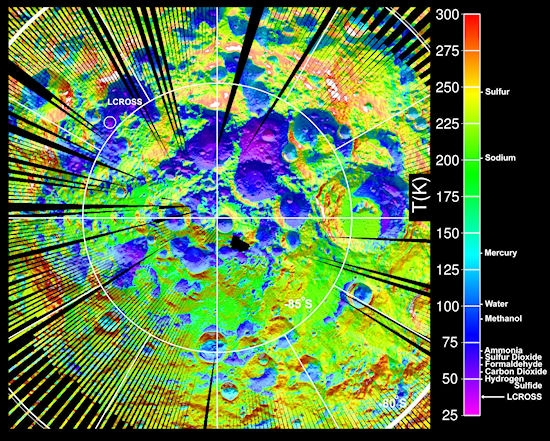
Above: A surface temperature map of the lunar south pole made by LRO's Diviner Lunar Radiometer Experiment . The map contains several intensely cold impact craters that could trap water ice and other icy compounds commonly observed in comets. The approximate maximum temperatures at which these compounds would be frozen in place for more than a billion years are noted at right.
-
UT RESEARCHERS DISCOVER WATER ON THE MOON IS
WIDESPREAD, SIMILAR TO EARTH'S - 21-Jul-2010
The scientists said this provides "robust evidence for the presence of water in the interior of the moon from where some lunar rocks were derived. This demonstrates a closer chemical and geologic relationship between the Earth and moon than previously known. We must now re-evaluate the volatile inventories of the moon, relative to the Earth." - OLD COMETARY SCARS ON THE MOON? caused by one at least 0.5 kilometers in diameter.
- COMETS, NOT ASTEROIDS, TO BLAME FOR MOON'S SCARRED FACE - 27 July 2009
- LUNAR CRATER CHAINS indicating comet strike. See Figure.
-
HBCC UFO RESEARCH RECENTLY REPORTED SIGHTINGS
Did Long-Destroyed 5th Planet Cause Lunar Cataclysm?
Planet V's close encounters with the inner belt of asteroids stirred up a large fraction of those bodies, scattering them about. The perturbed asteroids evolved into Mars crossing orbits, and temporarily enhanced the population of bodies on Earth-crossing orbits, and also increased the lunar impact rate.
After doing its destabilizing deeds, Planet V was lost too, most likely spinning into the Sun, the NASA team reported. -
GOING OVER THE WALL ON THE MOON
It's possible that the moon once did have a global magnetic field when it still had a liquid core and was spinning enough to get that magnetism thing going. - NEW 'MOON' FOUND AROUND EARTH
- NASA TEAM SEES EXPLOSION ON MOON
- * JUNO JUST SAW A SPACEROCK CRASH INTO JUPITER - Feb 18, 2021
-
THE COMET THAT BATTERED JUPITER, AND SHOOK CONGRESS - February 1, 2016
After Shoemaker–Levy 9 wrecked havoc on the solar system’s largest planet in 1994, for a rare moment on Earth politics were not parochial, but astronomical. Its political and scientific legacy still shines today - SCIENTISTS FIND SOURCE OF SATURN RING
An international team of scientists has found that the source of Saturn`s outer ring is water vapor from the planet`s moon Enceladus.
In an article in the journal Science, the researchers say that a plume of water vapor from Enceladus`s south pole has also given the moon a water-based atmosphere. They believe that internal processes within the moon are generating heat to produce the vapor. -
EARTH COULD SEED TITAN WITH LIFE
Terrestrial rocks blown into space by asteroid impacts on Earth could have taken life to Saturn's moon Titan, scientists have announced. -
JUPITER'S MISSING STRIPE, RETURNING?
Earlier this year when Jupiter's great South Equatorial Belt (SEB) vanished, researchers urged amateur astronomers to be alert for its eventual return. The SEB had come and gone before, they noted, and the revival was something to behold. Alert: It might be happening now. After months of quiet in Jupiter's south equatorial zone, a white plume is surging through the cloudtops where the SEB should be. Christopher Go of the Philippines took this picture on Nov. 9th:
Another impact on Jupiter? - GUARDIAN PLANETS JUPITER AND SATURN SHIELD THE EARTH FROM CATASTROPHIC COMET COLLISIONS - 31st July 2009
- ANOTHER NEWS FLASH FROM JUPITER - 20 Aug 2010
- JUPITER SPORTS NEW 'BRUISE' FROM IMPACT - 21 July 2009
-
HUBBLE SNAPS SHARPEST IMAGE YET OF JUPITER IMPACT - July 24, 2009
If whatever hit Jupiter — and astronomers might never know what it was — had instead struck Earth, it would have caused catastrophic damage to human civilization. - POSSIBLE IMPACT EVENT ON JUPITER - 20 Jul 2009
Did something just hit Jupiter? On July 19th, a black "scar" appeared in Jupiter's clouds similar to the Shoemaker-Levy 9 impacts of 1994. Veteran Jupiter observer Anthony Wesley photographed the feature from his observatory in Murrumbateman, Australia.
"The jet-black mark is near Jupiter's south pole (south is up in the image)," says Wesley. "I have imagery of that same location from two nights earlier without the impact mark, so this is a very recent event. The material has already begun to spread out in a fan shape on one side, and should be rapidly pulled apart by the fast jetstream winds. I recorded a lot of footage, and will be generating more images and a rotation animation soon." -
ALL EYEPIECES ON JUPITER AFTER A BIG IMPACT - July 21, 2009
Astronomers were scrambling to get big telescopes turned to Jupiter on Tuesday to observe the remains of what looks like the biggest smashup in the solar system since fragments of the Comet Shoemaker-Levy 9 crashed into the planet in July 1994.
Something — probably a small comet — smacked into Jupiter on Sunday, leaving a bruise the size of the Pacific Ocean near its south pole. Just after midnight, Australian time, on Sunday, Jupiter came into view in the eyepiece of Anthony Wesley, an amateur astronomer in Murrumbateman. The planet was bearing a black eye spookily similar to the ones left in 1994.
Dr. Marchis said the shape of the debris splash as revealed in the Keck images suggested that whatever hit Jupiter might have been pulled apart by tidal forces from the planet’s huge gravity before it hit. In an e-mail message, he said humans should be thankful for Jupiter.
“The solar system would have been a very dangerous place if we did not have Jupiter,” he wrote. “We should thank our giant planet for suffering for us. Its strong gravitational field is acting like a shield protecting us from comets coming from the outer part of the solar system.” - HAS JUPITER FLASHED BEFORE? - 24 May 2000
- THE STRING OF PEARLS A comet cluster or swarm resulting from the fragmentation of a 2 kilometer comet. The individual fragments were no larger than one kilometer, and each produced Earth size black spots on Jupiter. Such comet swarms have struck before, producing a
- CHAIN OF CRATERS
ON CALLISTO, one of Jupiter's moons indicating a comet strike.
None of Phaeton's anticipated comets possibly impacting Earth are expected to produce an impact crater the size of the K-T Event Crater that resulted in the extinction of the dinosaurs 65 million years ago. - JUPITER'S COMET IMPACT LEAVES MYSTERY
- JUPITER CHANGES ITS STRIPES
Jupiter's cloud patterns are undergoing dramatic changes, reveal new images by the Hubble Space Telescope. Similar transformations of the giant planet's clouds have been witnessed before, but never in such detail ?and they have never been explained. -
LOOK UP: WHAT'S IN THE SKY THIS WEEK?
Amateur astronomers Anthony Wesley in Australia and Christopher Go in the Philippines were the first to see another amazing asteroid impact on the gaseous planet's surface. National Geographic hosts the astronomers' video of the collision, producing a fireball the size of the Earth in the atmosphere. Astronomers are gobsmacked at timing of the event, so very close to the 2009 impact of a nearly mile-wide asteroid that left a scar the size of the Pacific Ocean on Jupiter (and was also first seen by Wesley). As Space.com notes, at the time Comet Shoemaker-Levy smacked into to Jupiter in 1994, astronomers thought such an impact would only happen every 50 to 250 years. -
JUPITER IMPACT: MYSTERY OF THE MISSING DEBRIS - Jun 12, 2010
Or
JUPITER IMPACT: MYSTERY OF THE MISSING DEBRIS - Jun 11, 2010
On June 3rd, 2010, something hit Jupiter. A comet or asteroid descended from the black of space, struck the planet’s cloudtops, and disintegrated, producing a flash of light so bright it was visible in backyard telescopes on Earth. Soon, observers around the world were training their optics on the impact site, waiting to monitor the cindery cloud of debris which always seems to accompany a strike of this kind.
They’re still waiting.
“It’s as if Jupiter just swallowed the thing whole,”
One thing is sure: “Jupiter is getting hit more than we expected,” says Don Yeomans, head of NASA’s Near-Earth Object program of JPL. “Back in the days of Shoemaker-Levy 9 (SL-9), we calculated that we should see an impact on Jupiter once every hundred years or so. We considered ourselves extraordinarily lucky to witness the SL-9 event.”
“But look where we are now,” he continues. “Anthony Wesley has observed two impacts within the past 12 months alone. It’s time to revise our impact models [particularly for small impactors].”